Uganda and South Sudan have signed a Memorandum of Understanding (MoU) aimed at removing non-tariff barriers, streamlining customs procedures, and reducing the operational costs facing traders along the strategic Kampala–Gulu–Nimule–Juba transport corridor.
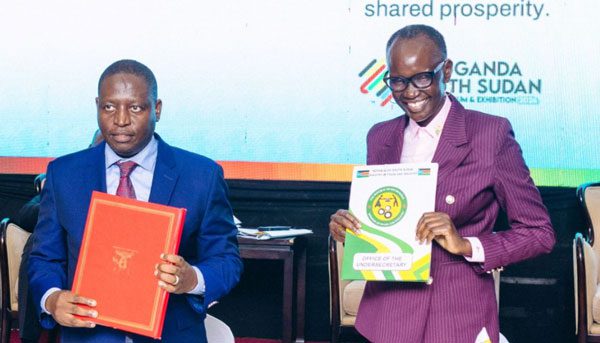
The bilateral agreement was formally signed on Wednesday, October 14, 2026, during the second Uganda–South Sudan Business Forum and Exhibition held at Mestil Hotel in Kampala under the theme “Easing the Cost of Doing Business and Unlocking Regional Market Opportunities for Uganda and South Sudan.”
The accord was signed by Uganda’s Minister of State for Industry, Hon. David Bahati, and South Sudan’s Minister of Trade and Industry, Dr. Labanya Margaret Mathya.
To ensure the agreement delivers tangible outcomes rather than remaining on paper, both nations agreed to establish Joint Technical Committees backed by a concrete roadmap, strict implementation timelines, and regular review summits to address ongoing border bottlenecks.
Overcoming Trade Imbalances and Border Delays
Addressing delegates, Minister David Bahati emphasized that the real test of the agreement lies in practical execution rather than diplomatic ceremony.
“We should judge the success of the MoU not by the signing ceremony alone,” Bahati stated, noting that progress will be measured by the trade barriers eliminated, businesses established, and cross-border jobs created.
Highlighting the trade dynamics between the two East African Community (EAC) neighbors, Bahati disclosed that trade remains heavily skewed in Uganda’s favor. Uganda exports goods worth approximately $524 million annually to South Sudan, while South Sudan exports $22 million worth of commodities to Uganda—a disparity partially influenced by population scale, with Uganda at 46 million citizens compared to South Sudan’s 12.4 million.
ALSO READ:
- Court Martial Convicts Wakiso Taxi Driver Over UPDF Attire
- Court Martial Sentences Two State Informers to Death
- Renegade Lt. Gen. Peter Elwelu Apprehended in Soroti City Over Subversive Activities
- Abraham Luzzi Slasts UEDCL After Blackout Interrupts Birthday Party
- Celebrated Comedian Kapere Passes Away
Bahati raised key concerns reported by Ugandan traders and transporters, including operational friction surrounding South Sudan’s electronic permit (e-permit) system, duplicate cargo assessments, multiple road checkpoints, informal levies, and uncoordinated operations between Uganda’s One-Stop Border Post at Elegu and matching facilities at Nimule. He also urged joint industrial cooperation in steel manufacturing to reduce the region’s $1 billion annual steel import bill.
Juba Reaffirms Open Market and Foreign Investment Protections
South Sudan’s Trade Minister, Dr. Labanya Margaret Mathya—a Makerere University alumna—reassured the Ugandan business community that Juba remains committed to protecting foreign investments and simplifying cross-border commerce.
Dr. Labanya clarified that a high-level presidential committee established by President Salva Kiir has already abolished alien registration fees and removed visa payment hurdles for regional travelers. She dispelled recent rumors regarding restrictions on foreign retail traders, affirming that Ugandan entrepreneurs operating across South Sudan—from bakeries to major markets like Konyokonyo in Juba—play a vital role in national food security and economic integration.
However, South Sudan’s Ambassador to Uganda, Paul Malong Akaro, noted that South Sudanese traders also face structural challenges, including difficulties purchasing directly from Ugandan manufacturers and distributors, as well as transit hurdles for fish exports bound for the Democratic Republic of Congo.
High-Level Diplomatic Commitments
Closing the two-day business forum, Uganda’s Minister of State for Foreign Affairs in charge of Regional Cooperation, Hon. Haruna Kasolo Kyeyune, reiterated that both governments must keep the private sector actively engaged under the regional frameworks of the EAC and COMESA.
Uganda’s Ambassador to South Sudan, Brig. Gen. Ronnie Balya, added that the joint technical oversight teams will build upon previous high-level bilateral engagements between President Yoweri Museveni and President Salva Kiir, paving the way for the upcoming Joint Permanent Commission (JPC) summit.
Discover more from SANTA MEDIA UGANDA
Subscribe to get the latest posts sent to your email.