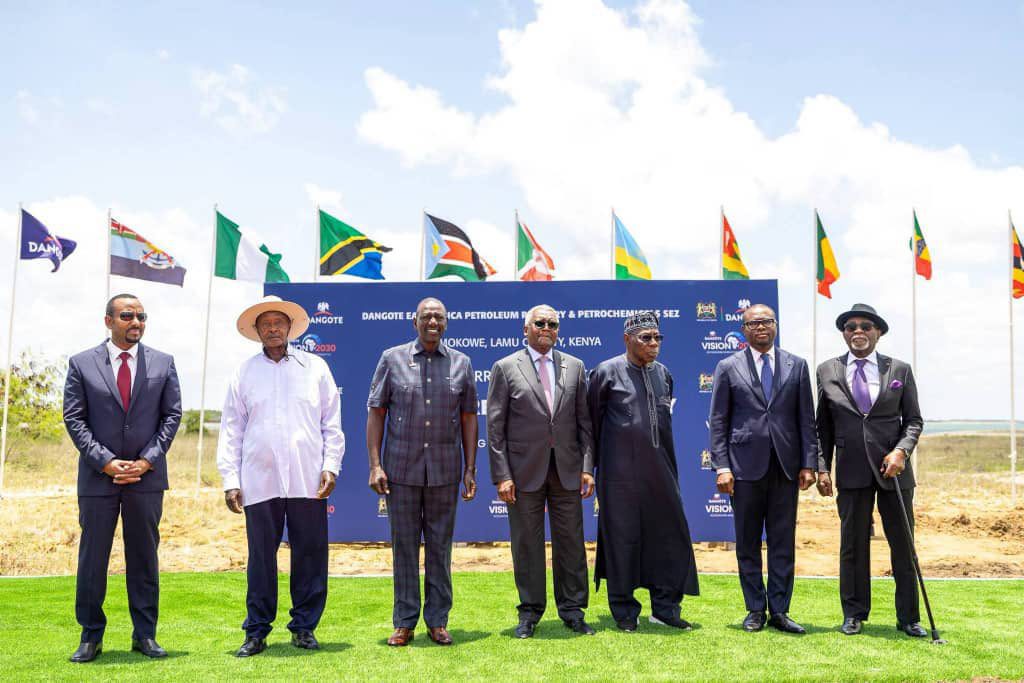
The economic landscape of East and Central Africa was fundamentally altered on Wednesday as industrialist Aliko Dangote, alongside five African heads of state, officially broke ground on the multi-trillion-shilling Dangote East Africa Refinery in Lamu County, Kenya.
The $16 billion mega-facility represents the Dangote Group’s largest single energy investment outside of Nigeria. Positioned as a catalyst for continental self-reliance, the project is structured to generate at least 60,000 jobs, reverse Africa’s engineering brain drain, and permanently end the region’s expensive reliance on imported refined petroleum products.
Kenyan President William Ruto hosted fellow regional heads of state for the landmark launch, including President Yoweri Museveni of Uganda and Prime Minister Abiy Ahmed of Ethiopia, alongside West African dignitaries Romuald Wadagni of Benin and Jean-Lucien Savi de Tové of Togo—underscoring massive pan-African backing for the initiative.
“Lekki proved that it can be done, Lamu must prove that it can be repeated,” declared Dangote Group Chairman Aliko Dangote during the ceremony. “I want to promise you that we will come back and commission this refinery 40 months from today.”
ALSO READ:
- Court Martial Convicts Wakiso Taxi Driver Over UPDF Attire
- Court Martial Sentences Two State Informers to Death
- Renegade Lt. Gen. Peter Elwelu Apprehended in Soroti City Over Subversive Activities
- Abraham Luzzi Slasts UEDCL After Blackout Interrupts Birthday Party
- Celebrated Comedian Kapere Passes Away
Originally slated for development in Tanga, Tanzania, the massive refining project was strategically relocated to Kenya’s coastal port of Lamu due to its unique geopolitical and deep-water logistical advantages. The refinery is structured to serve as an economic anchor and regional energy hub for an expansive market encompassing Kenya, Uganda, Ethiopia, South Sudan, Tanzania, Rwanda, Burundi, and the Democratic Republic of Congo.
Designed to produce over 100 million liters of petrol, diesel, and aviation fuel daily, the facility will directly mitigate currency devaluation risks through largely dollarized revenue streams while keeping billions of dollars within the regional economy.
“When you look at East Africa, not only East Africa, most of all the 54 countries in Africa, they import petroleum products,” Dangote told reporters. “What we are trying to do is to make sure that we become self-sufficient in whatever we consume. This is an African company to benefit Africa.”
Beyond energy output, the project represents a major human capital initiative aimed at training and retaining thousands of local engineers and technical professionals.
Drawing from lessons learned during the construction of the Dangote Refinery complex in Lekki, Lagos State—where initial technical skill shortages required reliance on foreign specialists—the Dangote Group is deploying intensive localized training programs from day one.
By establishing high-value, long-term employment for engineering graduates from Kenya, Uganda, and the broader region, the facility aims to build a world-class technical workforce that will naturally attract secondary manufacturing and petrochemical industries into East Africa.
President Ruto Cracks Down on Economic Sabotage
The groundbreaking comes shortly after President Ruto personally inspected the Lekki refinery complex in Nigeria on September 25. Addressing recent local land disputes, protests, and court orders attempting to freeze progress on the site, President Ruto firmly declared that the national strategic importance of the refinery overrides speculative friction.
Reiterating that the investment will secure long-term fuel reliability, stabilize local pump prices, and anchor Kenya’s industrialization agenda, President Ruto issued a stern warning to political actors and speculators seeking to derail the project.
“I want to tell you broker, niko macho mbaya sana. Hapa, hamtoboi bwana,” President Ruto warned, asserting that his administration will not permit economic sabotage to compromise key foreign direct investments.
Logistical deployment for the project is already under way. The Kenya Ports Authority confirmed that the Port of Lamu has received nearly 3,000 metric tonnes of specialized heavy construction equipment delivered by the MV Da Yang. Once operational, the complex will connect directly to ocean vessels via 120 kilometers of subsea crude cables, seamlessly transporting raw oil straight to the refining units.
Discover more from SANTA MEDIA UGANDA
Subscribe to get the latest posts sent to your email.